
Hello again,
Now it is time for the 2nd issue that MAY have a detrimental effect on your lawn –
LAWN GRUBS !!!!
Lawn Grubs (Spodoptera spp.) – feed of the fresh, young, green leaf of your turf just above the ground. They drastically reduce the quality and growth of your turf. This photo below displays a typical lawn affected by Lawn Grub –
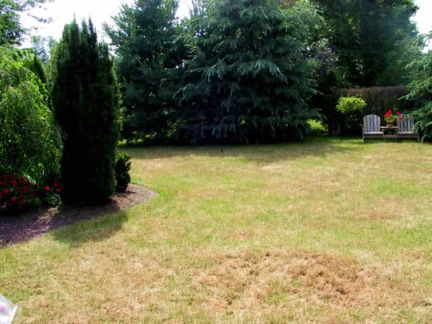
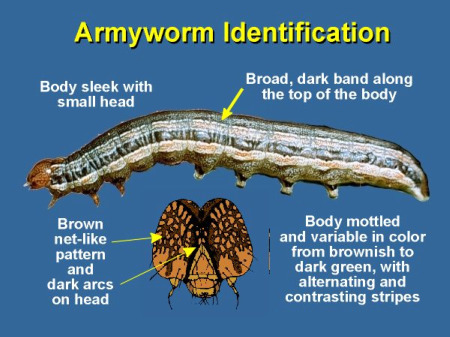
Common symptoms are – brown, dry and brittle turf. Closer inspection reveals the leaf blade of the turf to be eaten by something (as this photo displays). The actual lawn grub looks very similar to a caterpillar. (as this photo displays). They are range in colour from bright green to dark green / brown in colour with black dots down there back.

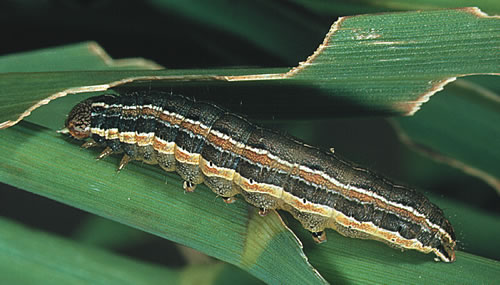
*NOTE – Lawn grubs are also known as ‘Armyworm’. This is because they start in one section of your lawn and work their way across the lawn along a set line, similar to soldiers in a battle.
Lifecycle – To best understand how to control and PREVENT lawn grubs it is best to understand there lifecycle. The lifecycle of the Lawn Grub is explained below –
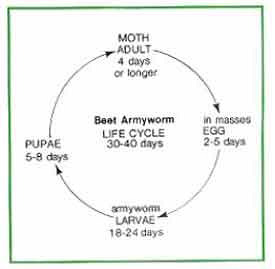
The adult Lawn grub is actually a moth, brown in colour. Please see the photo below –
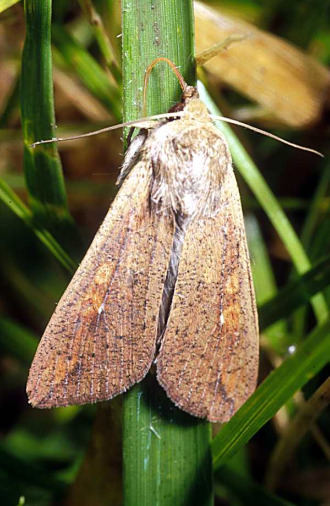 The adult female moth flies around at night and is attracted to well maintained lawns. She lays her eggs into soft cocoons on the awnings of your house, under side of leaves and even your clothes line. These cocoons look like this –
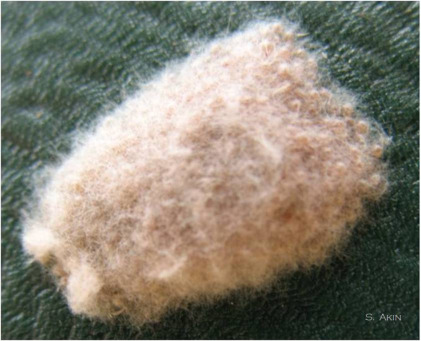
These cocoons then hatch into the caterpillars (or LARVAE). These caterpillars are the ones (lifecycle stage) that do the damage to your lawn. They will live for approx 3 weeks if allowed to. However it is best get rid of them ASAP.
So how do we get rid of Lawn grubs ?
Control Methods –
Chemical control: A range of insecticides are registered for the control of Lawn grub in turf. These are readily available from your local hardware or nursery. If possible spray late in the day as the Lawn Grub / Larvae are active at night.
Cultural Control : By breaking the lifecycle of the lawn grub you are able to PREVENT any lawn grubs getting into your lawn in the first place. This is best achieved by keeping an eye out for the soft cocoons on your awnings and gardens and either brushing or hosing them off. This will kill the eggs, hence not allowing the Lawn Grub / Larvae to eat your beautiful lush lawn.
Additional info – Lawn grubs are more likely to occur after rainfall. This is because the grass is lush and green. Therefore keep an eye out for the moths and cocoons after rain.
*Turf recovery – even if your lawn has been completely eaten by lawn grub (lawn looks brown, brittle and dead). Your lawn will recover. The best thing to do is –
1). apply a chemical insecticide to kill all of the existing lawn grubs (make sure that you do this first BEFORE fertilizing, as if you fertilize first you will only be ‘feeding’ the existing lawn grubs).
2). Fertilize your lawn with ‘Scotts Lawn Builder + Grub and Insect Control’. Found in Bunnings a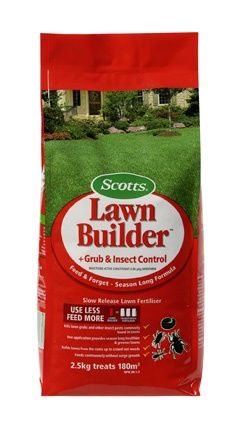 nd most local hardware stores. This product will fertilize your lawn to enable a quick recovery and will also ensure that NO lawn grubs survive.
3). Water / irrigate your turf for 2 – 3 days after applying fertilizer to ensure a quick recovery !
I hope that this info helped !
If you have any questions specifically about turf please feel free to email them to us at [email protected]
Many thanks for this info .. your symptoms have been ‘spot on’. I am at stage 1 of “turf recovery”. As you suggest, (and from our second home, Bunnings), I have applied Yates Baythroid with the results being almost immediate ,(slow moving curly grubs), using a mix of 1 capfull to 9 litres in a watering can.
For your info, in this instance the grubs were inherited from my neighbour who has just had infected turf laid. He hasn’t undertaken to treat his lawn as yet, so in an attempt to halt the march, I have applied a double strength dose on both sides of our fence line. Hope it works. Again thanks.
Regards Jim A
What a find, your wesite was excellent in explaining the lifecyle of the lawn grub. I was searching for a site to explain to a client about the lawn grub and how it happens etc. Your site is very informative and easy to read. I have my own small garden care business and regularly search for info for clients. Thank you.
THANK YOU SOOO MUCH been trying to figure out what was wrong with my lawn all year finally I can do something about this. Thanks again
Just wondering should I do the turf recovery even though I have sod in its first year?
very helpful thank you. i am on a 5 acres block…after some earth moving work which effected 1/2 an acre i brought in top soil, turfed about 200sqm and used seeds on the rest. with the rains everything was beautiful within weeks; 2 weeks ago within matter of days the whole seeded area turned brown and now the turfed area as well gradually go brown. i spotted the lawn grubs now and did some reading. various products are suggested including both dry and liquid based…and i am not sure what to use. any suggestions ? also it is raining now almost daily and given this condition what’s the best procedures to apply ? would these grubs also attack other plants & trees ?
Nemadotes is another form of controlling the grubs…any comments on this ? thanks
hi
i have sprayed my lawn with grub destroyer.,and the next morning i noticed all these small brown moths. what does this mean
regards
terry (AUSTRALIA)
hi
i have sprayed my lawn with grub destroyer.,and the next morning i noticed all these small brown moths. what does this mean
regards
terry (AUSTRALIA
Hi,
Sorry it has taken so long for me to return your mail, but my foot has really slowed me down.
Ofter some consensus in the office this morning (without seeing your lawn) we believe that what may have happened is that either your lawn grub killer was rained out or the moths are from next door. Unfortunately lawn grubs need to be killed neighborhood wide or they keep returning to your treated lawn. Try to keep our lawn treated every 2 weeks as Lawn grubs have a life cycle of 2 weeks so knock them before they get to bad.
Thanks
Sarah
Some Nemadotes are indeed a form of pest control, but not that effective on army worm (due to its short life cycle, and the fact that they live in the lawn thatch rather than the soil). these micro organisms can have good and bad effects on your lawn and its environment. They are most effective in effective in the controlling of organisms such as curl grubs or African Black Beetle larvae.
Thanks
Sarah
Good Morning,
Sorry for the late delay but I broke my foot at the very wrong time of the year.
I have talked to our installation team as well as one of our recommended lawn contractors who believe ( now this is without seeing your property and we can’t really make an accurate diagnosis but can offer some advice) that drainage may part of the problem with your area. For the seeded area to go first and then the turfed lawn area the boys are bit wary of it just being lawn grub. Lawn grubs love thick lush warm grass to breed and eat so it was expected that the turfed area would go first with lawn grub. Where as lawn grasses dont like to have their feet too wet.
we usually recommend that people with children and animals especially use the granulated lawn grub treatment as these are less likley to come in contact with children and pets as they run across the yard. Please though make sure everyone stays off the treated grass as recommended by the products user manual.
Thankfully lawn grubs as their name suggests with effect Lawn and grasses not shrubs and tress, but keep watch on these for other water loving insects.
Thanks and we all hope that your lawn survives. the Installation team also recommends that you also treat any other turfed and lush lawn areas as the lawn grub moths can will attack these areas next.
Sarah
Hello
I’m on two acres and most of my lawn is full of small balls of mud. Is this from army worm and what would be the best way to control this?
Many Thanks
No Richard this most probably not from Lawn Grubs but from Ants trying to build their nests higher to get away from the rain. There are losrt of different types of ant controll, and really for such a large area I guess cost will become an issue for you. We usually recommend an ant sand that is activated by water. But this may prove to be costly over 2 acres. An Ant barrier could be used around your property. I suggest calling your local lawn consultant.
Thanks Sare
for some time I’ve wondered why my lawn would apprear to die after heavy rain. And I had never connected the dots till reading this… seeing all the moths, then all the eggs under the eaves, followed closely by the lawn progressively dying. Now i know how to break this cycle… thankyou….
We have new turf, that has been very well watered in lately by all the rain, and this morning have found caterpillars EVERYWHERE… throughout the lawn, and climbing the house, retaining walls etc. They look a lot like your picture of Armyworm- although the head isn’t brown but the green. Do you think it would still be Armyworm/Lawn Grub or something else? They are very active now, during the day. Not sure yet if they are still active at night too. If they aren’t Armyworm, but another species, do I use a different insecticide or will most cover me for any kind of caterpillar?
Many many thanks!
Hi there, my couch was completely eaten by lawn grub then the moved over to the sir walter across the drive and out the back which is still holding up a little, unlike the brown couch.
I sprayed baythroid last night and wondering how long before I see dead bugs and how long before I can fertilize and try to revive my lawn?
ALso, should I repeat the treatment etc? so guess I need a process, a timeline of what to do when.
Sharon
I’m so glad we could help.
Hi, Without actually looking at the grub itself we do believe that it is a type of Lawn grub/army worm. And being so we believe that the same products will wipe them out – the nasty little pests. I prefer the sand granulated lawn grub killers because they are quick and you don’t have to mix them up. But if you choose to use a liquid chemical lawn grub killer as my Dad likes because he can see them die ( Dad really hates lawn grub with a vengeance) he suggests you use “loresban” mixed at 5% by volume and then add a wetting agent – this means something to make the chemical water mix stick to your grass/walls/etc. Dad uses ordinary washing up liquid. The cheaper the better he says. Both of these products can be bought at your hard ware store. Good Luck in your war against your invaders. May you rein supreme.
Hi there, I’m really sorry to hear about your lawn. Couches are a lovely sweet grass that lawn grubs think is delicious and will eat until there is no more. They will gorge themselves like its chocolate. Where as Buffalo’s are a courser grass that doesn’t taste as good, so lawn grubs really only eat their fill. And unfortunately lawn grubs can fly up to 5 ks to find a delicious lawn. So no real lawn is safe.
I am sorry but I am unaware of Baythroid. I like using a sand granulated lawn grub killer as it gets down into the roots, but Dad likes to use a liquid one because he likes to see them squirm and die. He hates them. At home I use Lawn Beetle and Grub Killa because I have kids and a husband (who’s job is to look after turf look all day so doesn’t want to do it at home), and I don’t need a spray kit to disperse it. It’s active ingredient is Bifenthrin. It works within 3 to 4 days.
Dads way is a mix “loresban” at a 5% rate in water with a wetting agent (ie cheap washing up liquid) and spray the lawn at dusk. This will also take 3-4 days to kill them, but the advantage to the liquid is that as soon as you spray a bug you can see it dire and you know you are getting them. Also you may not actually see the dead bugs, but you may see lots of birds sitting on your lawn eating dead bugs. Also satisfying.
As for Fertilization and top dressing, Autumn is really the best time to add all those wonderful nutrients to your lawn. This is the time the plant is really looking for food before its winter resting time. For right now though, I would wait until you are sure that tall the bugs are dead. This may mean spraying 2 times as I don’t know if the grubs have laid eggs that will hatch and attack your lawn or have moved onto the neighbors. It’s really a case of getting down into the lawn spreading the leaves and having a good look in there. When you are sure you can’t see any, and this may take weeks, go to your local Landscape yard and ask for an Organic boosted top dressing soil. It should smell horrid as it will have more than likely chicken poo in it. And spread it just before rain or water it in.
Sorry I can’t give you an exact time line, but something like that kinda needs to looked at to know. If you have any problems give us a try back or contact your local turf farm and ask them for their recommended lawn technician.
Thanks Sharon hope it all goes well. As always good luck in your war with the Lawn grub, may you divide and conquer!
Sare
Hi
We came home after 3 weeks of holiday to find our lawn dead and covered in worms that were identified as army worm. We sprayed them and now 2 weeks later the lawn seems to be recovering some what but I am worried we are getting them again. At dusk there are moths all over the lawn and ever morning there are new cocoons on our awnings. I brush the cocoons off every morning but is there anything else I can do?
I really don’t want to have to spray again because we have 2 dogs and had to keep them off the grass for 3 days and the back garden really stank but at the same time I don’t want armyworm again! Do the moths just die off eventually or will this be a constant battle? Should I use Scotts Lawn Builder + Grub and Insect Control? and Do you know if that is safe for pets?
Thanks
Sarah
Hi Sarah ( great name by the way)
Army worm has a very short life cycle so re treatment may be required. The unfortunate thing is that with lawn grub you have to wait for the lawn to be actually effected before treating. There is no precautionary spray etc that you can do to prevent re infestation. Your dogs should have no ill effects from treatment, if you are worried then maybe an Ant Sand is for you rather than a spray as it sits in the lawn rather than on top of the leaves of the grass. I think lawns are meant to be used, so you should find away to kill grubs and still be able to enjoy your outside grassed area. Also rotating spray types/ chemical type can prevent grub resistance for those really stubborn infestations. I prefer the Ant sand with Lawn grub killer in it because I know that my kids are safe. They have no patients to wait for the chemical to dry and I prefer them outside than under foot.
I haven’t had much to do with the Scotts Lawn builder, but the reason your lawn was attacked in the first place was because it was lush, so I would be a little worried about making my lawn really lush and delicious for the worms while trying to kill them. Maybe as a last meal or something? The best time to fertilize and boost your lawn is the end of February or beginning of March. This when your lawn needs that energy boost. I would at least wait and be certain that all your evil little grass nibblers are dead before you boost and fertilize your lawn. Top dressing your lawn with really smelly organic top soil mix (needs to be smelly like chicken poo because that means its fresh and has all the great nutrients ready for the grass) is a great way to bring it back. Try to do this before rain so the soil can be pushed down to the roots where the plant needs it and also the smell doesn’t stay around you too long. Quick tip though always ALWAYS close all your windows and mention to your neighbors you are going to do it or they may call the council to stay a sewerage line has burst at your house. That actually happened to a friend of mine. Embarrassing for the installer and neighbor a like. Good luck,
Sarah
Is there any way of stopping the moth making the cocoons all over my house?
Hi,
Unfortunately I have seen the moths building cocoons on wooden houses, brick homes as well as rendered homes. They just love the comfort of eaves. I don’t know of any spray or wipe you can put on your house to stop them. And if the “natural” place they really are meant to build them is under leaves on trees, we can’t even make it too uncomfortable for them. You can knock them down as soon as you see them. That’s really the best advice I can give.
WE TOO ARE SUFFERING FROM THE LAWN GRUB INVASION AT PRESENT – CAN YOU PLEASE TELL ME IF THERE IS ANY CONNECTION WITH THE LAWN WASPS HANGING AROUND ON THE GRASS AND THE LAWN GRUB CYCLE?
PS: OUR FRIENDLY BIRDS ARE ENJOYING THE FEAST I MIGHT ADD!
Yep there sure is a connection between the two nasty blighters. The wasp actually eat the grubs. But not enough as far as I’m concerned. There should be more feasting and less making nasty cocoons on my walls. And birds area a great way to know if you have lawn grub or not. Once they start to hang around your lawn a little too much you can see the grubs around. I have tried to be proactive at our house and feed the magpies and will wag tails so I can keep them around to eat any that should arise, but I only succeeded in attracting Scrub Turkeys and Ibis. So I stopped throwing out day old bread for the birds and sprayed the lawn and wash down the walls regularly. When I say regularly I mean when I can bribe my kids to do it. Good luck and spray quickly.
Sare
Thanks for the info. It was extremely helpful.
For lawn grub treatment and considering a pet dog who loves foraging in lawn, our local produce store suggested using Fortune 500 with a treatmen dosage of 20 to 40 ml /100 L water (as per product instructions). Results – very successful and will follow up in 2 weeks. As for the dog, smell kept her off the lawn for a few days,now back to foraging lizards in lawn.
So glad that it worked on your Lawn. There is nothing worse that Lawn grubs! Ahhh, well at least to a turf farmer…. Glad you are going to have a healthy lawn and a healthy dog, and it seams not so healthy lizards if your dog gets their way
Cheers
Can anyone tell me the correct application rate of Fortune 500 for the treatment of army worms?
Cheers
Have lots of lawn grubs at the moment but also lots of birds feeding on them.
My concern is, are the products mentioned here harmfull to the birds and if so can you name others that are not.
Thanks
Hi & Thank you I have just been reading all the advice, It’s Great!!!!! just wondering if anyone knows where I can buy bulk slow release fertilizer & bug killer like the scotts one or even that one as I have quite a large area that needs to be done and the small bags from bunning’s don’t go far and gets a bit expensive but it works a treat… thank you 🙂
Hi Brian,
we don’t use Fortune 500 or have a lot of knowledge about it, but we do use Loresbane, which after a bit of research think that it may be similar. We use Lorsbane at a 5% by volume ate with water with about 30mls of dish washing detergent as a wetting agent. But when you are using these products we really advise you to keep all small animals and kids off the lawn for at least a week.
Good luck Brian, and I hope your lawn blooms soon
Sare
Hi Tony,
Lawn grubs are killed with pestacides. And there in lies the problem. There are sand granulated lawn grub killers are safe to use around wildlife. So go and ask your local nursery for their expert advice. Explain to them your lawn type (ie if its couch or buffalo or zoysia as this will let them know the gaps between leaves) and they can put you onto something that is right for you. But like hairdressers, your Local Nursery should be one that you feel comfortable at.
Good Luck
Sare
Hi Annette,
I know! Bunnings sells little tiny bags for what we at Coastal Turf consider to be an exorbitant price! We had customers he other day who came to buy organic booster from us (similar to Dynamic Lifter without the fancy name and packaging) and Water crystals from us. We charged her about $90 for everything to cover a 300sqm plus. At Bunnings they quoted her roughly $1000 for the same area. So when you are getting your turf ask us for the Booster and Water crystals at the same time. But if you aren’t anywhere near us ( we are on Cabarita Beach on the Tweed Coast) go to your Local Rural Buying Store and See what they have – Places like Norco. Be careful with Lawn builder and bug killer in one. I am just hesitant recommend them because i feel that if you don’t kill all the bugs you have just feed the grass to make it yummier and then the bugs have more to eat.to They usually have a much better deal for you, and being a local company they are keen to help locals. All about reputation! But definitely fertilizing your lawn now is a great idea because Autumn means plants are getting ready to rest and need food to “stock up over winter”. Kinda like a bear my brother describes it as. Its also a great time to top dress your lawn to give ot warmth and nutrients over winter. Head off to your local Soil supplier and ask for their best organic top soil and watch your grass grow?
Hi Sarah, We have lawn grubs and are trying to keep them in control. Thanks for all the info on them. We have learnt so much but were a little down hearted when we read we will have to keep it up every 2 weeks! There were magpies and butcher birds hanging around but not for the last week or two. We were thinking of getting some hens. Do you know if they eat the grubs? very frustrating as we are only renting this place and keeping the grubs in control has become ridiculous both time and cost. thanks
Hi Tina, I have heard that Lawn grubs are a tasty treat for Hens, but in order to get to the grubs, hens do try to rip up the grass. Very Very frustrating. I guess its kinda like a kid with nits, if you can get all of them the first time with vigilance and patience, the follow up treatment 14 days later is just precautionary. But if your neighbors aren’t getting rid of the grubs in their lawn they can return. Look around t your eaves and windows roofs and the leaves of your higher plants for the egg sacks. They look like a mossy brown fungus growing. If you can kill them, by wiping them down with a cloth from your washing up, then you can really help stomp on the problem. Although Lawn Grub season is nearly over. Hopefully the cooler times are coming and the rains should start to wain, so the perfect hot humid weather for the grubs is gone, so your lawn will be safe, for the winter anyway.
Thanks Sare
I have been away from home for three weeks and on return i found my lawn had an attack of the GRUB, the turf is PALMETTO, on inspection of the house roof eaves i had numerous cuckoons which i wiped ou tplus my passion fruit vine had quite a lot of wasps buzzing around and they still are today, could they be hunting the moths? i immediately sprayed the lawn with BAYTHROID.My main question which i hope u can answer is.
Why does a section of the turf where the main attack was about 40m2 have runners on the surface, has the grub caused this to happen? if so can u please help with how i can fix it (shouldnt the runners be below the surface)? the rest of the lawn is normal. Regards
Hi, there sure is alot of information here about the dreaded lawn grub. I have empire turf that is supposedly resistant to the grub, yet i am experiencing similar symptoms. The lawn is very patchy and in some places it looks almost as though it’s been bleached. I’ve also noticed alot of little mounds of dirt that look like the signs of earthworm but they are appearing in the dead patches of lawn. There aren’t any signs of the grass leaves being eaten that i can see, but the lawn seems to be dying from the roots up i.e. there are still some bits of green on the top but the roots have all gone brown or white.
I’ve sprayed fungicide and i’ve tried grub destroyer but the lawn still looks disgraceful. Any recommendations?
HI,
I think you may have Funnel or Tunnel Ants. Go down to your local Nursery and get some Brigade. It is a sand granulated evil ant killer. It works really well on Green Ants. Put is on before rain or drench it when you apply it and the ants will rise to the surface dead, and bird food. These ants will eat the roots and that is whats causing your lifelessness in your grass. Give it a couple of rounds though to make sure you get them all. By killing these ants you will be giving your soil extra health becuase the earth worms and other “good” grubs will come back.
thanks
Sare
Thank-you so much for your hasty reply and you recommendations. I can’t wait to see my lawn back up to it’s usual standard.
Kind regards
Jim
Hi,
Both my father’s lawn and mine have had lawn grub for about 2-3 months now and for the same period we have used the old remedy of using washing power and water to bring them to the surface. Well it brings them to the surface alright, but the grubs are still present. Am I wasting my time with this remedy and is it time to go for a real chemical to knock them out once and for all?
thank you … Christina
Hi
This is not a remedy that i am familiar with. And it doesn’t sound like you are having a lot of success with it either. I do think that probably you are looking at a chemical control measure now. I would recommend (not knowing where you are though I cannot give you exact ideas but)using either Lawsband or Chlorpyrifos at a 0.5% ration in a spray tank with a little washing up detergent to help it stick to the blades of grass. And make sure that you spray your lawn at dusk, that is when the grubs are at their most active. Then repeat this spraying of all your lawns in 10 days time to kill any that may have hatched.
Also make sure that all your eaves and fly screens and any wind protected damp areas (I found eggs in my bathroom once) are egg free. They look like moss and clump in areas as big as your thumb nail. Wipe these areas down with washing up liquid and water with a small drop of tea tree oil. This will kill the eggs as well as deter them from returning.
Good luck and let me know if if you need any more help.
Chat soon
Sare
Hi,
Is there any connection between lawn grubs and the red and blue dragonfly looking insects that hover above the grass. They have a long stinger also, I can remember when I had lawn grubs last year these were around. I don’t want the grubs again, took ages for my lawn to recover!!
Have just arrived home, Scotts Head NSW, after 2 months and found 6 big round rings of dead grass with live grass in the centre on our lawn, 4 are 1.5 metres wide and 2 are 1 metre wide. The next door neighbour has 3 patches. I dug up a section of 2 rings but couldn’t see any insects. What sort of pest could this be & how do we control it?
Cheers
Jenny
Sounds to me a bit more like a fungus infection, but since I don’t know what type of grass you have I can’t be sure. Let me know how the information I sent you went.Sare
ABSOLUTELY! I believe that these bugs you are seeing are the wasp like creatures that eat the larvae of Lawn Grubs. This is a great indicator that you have lawn grubs before there is any permanent damage to your lawn. Great observing! Get on with your Lawn Grub killing straight away! Sare
Can you tell me a name of the salt based granules to put on our yard?
Joanne
Hi Joanne. I am really sorry but I have asked around 2 landscapers and 3 yard maintenance guys that I trust and respect and none of us know a salt based granule. We were even thinking that depending on the grass that you have that putting salt on your lawn may have a very detrimental effect on it. Salty water can be a lawn killer. If it is a granule and does need watering in like say Ant Sand, then please be careful of the salt level content. We have found the And Sand to be the best environmentally careful Lawn grub killer. It will not activate until wet and then it requires contact to kill the lawn grubs so it doesn’t harm other fauna.
Sorry not to be more help.
Sare
Hi Sarah,
We definitely have lawn grub. Along with a million moths & wasps. We have applied one dose of ‘beetle destroyer’. However I’m unsure of the following……should we mow it 7 days later? Reapply? If so, how often and should we wait and fertilise at the end of February as previously stated?? We are about to market our home so I need remedies! Please help!!!!!
Hi Samantha,
Oh how horrid.
I am a big believer in reapplying the Lawn Grub killer again. That way if any new larvae have hatched you will get them as well as well as any little ones that you may have missed. I am not that familiar with your brand but the brand that I recommend to others on the phone says to reapply 7 days after. And do’t forget to keep watering your lawn! Water activates the chemicals and also helps your lawn to fight through it’s infection.
I would also suggest that you make sure that your lawn is completely lawn grub free before you fertilize and feed your lawn. Other wise you will just be making their meal that little bit tastier. I know that others have different opinions, but I believe to kill them off first. Also make sure that their eggs are all gone from eaves, doorways, flyscreens, and little out of the wind areas. I have even seen them in peoples pegs on their clothes lines.
To check for anymore lawn grubs placing a damp towel or blanket on our lawn over night and then checking the next morning underneath for any bugs is the most obvious way to see if you have got them all. If you see any reapply reapply. And try and convince your neighbours and friends to do so as well. This way you limit your likelihood of future infestations.
Then a quick haircut and a feed is in order. By keeping your lawn cut short you can limit weeds in your lawn. Sea weed based fertilizer are great this time of year as are Chicken poo. But sea weed smells lots lots better! Both need water when applying and will give great green quick results. I also suggest that if your lawn is badly attacked that Top dressing your lawn may be in order to put it back to its optimum health. Go to your nearest trusted landscaping supply yard and seek out their smelliest soil and get a cube per 100sqm of lawn. THen spread this across your lawn so that the leaves are poking through, a little deeper in the badly effected areas to bring all your lawn to the same height. Then again water it in until you can’t smell it any more. I also recommend closing all windows near you to keep the smell out of your house and if you like your neighbours give them a little warning.
Hope I have helped and the sale of your home goes well. Please let me know if you need anymore information.
Sarah Mason
Coastal Turf
WOW I am so glad I stumbled across this forum as we have been trying to work out what has been killing our very well maintained Palmetto, it seemed to start in one patch and is spreading in a line as described, I also discovered a extreamly large moth in the yard the other morning (have never seen one like it before) not sure if it is the moth you are talking about but it’s body was huge and very grub like, after reading this forum I went and checked the underside of the leaves on our gum tree (which hangs out over the entire lawn area) and it appears to have small cocoons on them as described but have not seem any grubs to speak of, now after reading another post on here about tunnel ants I am wondering if this could be a cause also as some time ago big ant piles were present throughout the lawn area. We too as John Wyatt’s question have runners sitting on top of the lawn in the dead patches I did not see a response to his question but is this normal or should the runners spread below the surface. Thanks in advance 🙂
Sorry I said John Wyatt and it was a question from Gilbert Whyte
Hi Kellie,
So to begin with the runners across your dead patches are very very good! It means that your lawn is trying to repair itself. Palmetto like most turf grass sends it runners across the ground and the. At the joints(where the leaves usually come off the stem) they send down little roots. This allows the palmetto to establish itself where it can find food or water rather than sending out millions of runners and some dying off, it sends them to where the plant is already being feed.
The moths you are describing are similar to what I have seen as the adult form of the lawn grub. You may not be able to see the grubs at the moment due (pending on where you are) weather variations – like extreme rain and or heat and the grubs have gone deeper into the lawn to survive, life cycle, and the different areas that are in your lawn.
Tunnel ants will most likely be causing your piles on your lawn. They have a detrimental effect on your lawn as well.
I really strongly suggest that you get yourself some ant and lawn grub sand from your local nursery. The Scott’s brand is great or a mixture called Brigade is wonderful. If you are getting the aim we are out it out now and then in 10 days. The sand mixtures are water activated so now is a great time. Also the lawn grubs tend to spring into life after rain- kinda like Mosquitos.
Hope you get Ll the nasty little things in your lawn. Palmetto is very aggressive as a turf grass so it should make a quick recovery. I would also suggest that in the change of season that you give your lawn a top dress and feed to help it fully recover before winter.
Chat soon
Sare
Samantha. Just a quick word of warning that after this huge lot if rain the lawn grubs will be back in force! I would reapply the lawn grub killer straight away!
Hope your lawn is returning
Chat soon
Sare
Hi
We have lawn grubs, but we also have 2 rabbits. How long after using an insecticide on the grub infected lawn before we can let the bunnies eat the grass again???
Hi,
I think the time before animals and kids can again rein the yard depends on what type of insecticide you are using. Try checking the back of your insecticide for full details. Sorry I can’t be more help.
Sare
Thank you for this informative article on the Lawn/Army Grub. I have just treated my entire back lawn (large area) with Munns Granules and it killed them within a few hours after watering in during early evening. There were so many it was amazing. As my lawn was badly affected ( I initially thought was due to lack of water and very hot weather) do I have to cover with a layer of new soil? Amongst the lawn there are a lot of bare patches and dead grass. Some have shoots so not sure if all will recover?
Thanks again
Hi Paula, It depends on what tyoe of grass you originally had as to how quickly the grass should recover the dead patches. But Turf grasses grow from runners so it should recover. Just watch out for nasty little weeds trying to get in first in the dead patches. So glad the article helped you and you got onto the cause of your lawn problems. Don’t forget to look around covered areas and eaves to get rid of any eggs that are left. Thanks again for the positive feedback. Sare
Hi, yes lawn grubs are out, I say… We are in qld and with all the rain, our back lawn came back to nice lush green and now the lawn grubs got into it. Heaps of dead army worms about. The front lawn is still nice and green. Have also treated it just in case with that spray on stuff. We have blue couch grass, quite hardy, so hoping it will come back quickly. Do you think we should still fertilise with the Scott’s lawn builder and insecticide? Ou neighbours have the sir Walter buffalo. Nice and green, I did warn them about lawn grub…sicknof cleaning the brown stuff from underneath the eaves, but it is not as much now.
I suppose the question I have now is how long before I should re treat the lawn?
Hi Tanja,
I think the meanest thing about lawn grubs and the lawn devastation that they leave behind is that they do go for the well looked after lawns.
The reapplication really depends on what type of spray you have used to kill them. Some sprays have a longer “shelf life” than others and the sand granulated based killers are different again. Have a look at your back label of the chemical you used and go from there. My rule of thumb is when you see eggs, throw a towel on the ground over night and see what if anything comes up. If you do see the nasty worms, hit it again.
With the egg wiping, my best “Old Wives Advice” is to get some dishwashing liquid in warm water and add some tea tree oil or some eucalyptus oil to the water soapy water and wash down the areas. The moths don’t like the sticky feeling on their feet (or that’s what I have been told) and they are repealed by the smell. It is an old wife tale but it has worked on our sheds.
Also keep an eye out on your neighbours lawn if they look like they have an infection hit your lawn again.
Your Blue couch should come back and with the change of season approaching fertilize then with an organic based fertilizer. Top dressing may be the best way to go considering you may have small dead patches across your lawn. The nutrient rich soil will give the Blue something delicious to grow in. I like spreading the soil before rain as it can be a bit smelly and the rain washes all the smelly (but great for your lawn) parts down to the root system.
Chat soon
Hope all goes well
Sare
Hi. I have had army grubs in our crop of millet. We have mulched it and ploughed it in. We spread chicken manure and ploughed that in before planting the oats which came up. Now the army grubs have eaten it. I was wondering how long before it is to cool for them as we would like to plant again for our winter feed, or have you any suggestions. We sprayed the area around the farm with Fortune 500 which killed the grubs in that area. Thank you I now it is a lawn but we need help with this.
Thanks for getting back to me Sare. I will try your trick with the tea tree oil… they have reduced building their little cocoons. I wiped down yesterday, mind you had a few new ones there this morning, urgh (we had some rain last night). They seem to be “marking” by ceiling just by touching with their wings and flapping about, gggrrrr… I broomed the entire ceiling yesterday and it needs to be done again. The lawn is already looking better to me, after the little rain. Will keep on top of it and do the towel trick. We applied the Brunnings spray on lawn and grub destroyer. Thanks again.
hi i have sprayed for lawn grubs cleaneed all the eaves but still have lots of moths at night what do i do now thanks ken
Hi Margaret.
Try Loresban for the grubs. that’s the best insecticide we have found. What do you need help with now? The lawn?
If you have killed the grubs in your lawn, then try fertilizing the area with chicken manure or top dressing it with the beginning of autumn coming.
Let me know if I can offer an more advice
SAre
Ken, How close are you too and with your neighbours. Although you may have licked the problem at your place, your neighbors may not be as vidulant. Check around and maybe offer advice….
SAre
Just found this site,great info here.
Have read all the comments very informative.
I live between Brisbane and the Gold Coast and noticed a lot of brown moths flying over my lawn at night.
My question is..
1. After spraying with an insecticide when would you spray again?
I still seeing moths flying over the lawn after i sprayed a week later.
Steve
I have just treated all the nasty lawn grubs with a powder that seems to be killing them. Do I need to do it again in one week’s time?
Hi Kylie,
Have a look not only at your lawn but around the neighbours as well as see if there are any signs. If you do, then I would sprinkle it out again.
Hope it all works
Sare
Hi Steve,
Have a look at your spray info sheet and see if it recommended you give it another hit. The best time to spray is at dusk as this is when the bugs are most active. Loresband is awesome at dusk for knocking them dead! We always add a little bit of washing up detergent to make sure it is tacky and sticks to bugs.
Watch out that the moths aren’t out laying new eggs around your house too. Wash all your eaves, windows, roofs, all damp out of the wind areas.
So in answer to your question, yes I would spray again, just to be on the safe side, as spraying is contact based where as the sand granulated ones stay in the soil for longer. And I would definitely wash all the walls eaves, etc for the eggs that are going to be hatching out soon.
Hope all goes well
sare
Hi could you tell me the mix i should use of chlorpyrifos 500ec for lawn army worm as i need to know how may mls per liter of water i need as it only tells me mls per ha cheers Scott
Hi i sprayed with grub 500 and a heap of grubs come to surface does that mean they have died or will die
It means they are going to die. haha. You have got those ones, but don’t forget to clean your eaves and windows to make sure no eggs have been laid. Check for new ones next week and maybe apply again.
Chat soon Sare
Hi, we use it at 5% per volume.
Chat Soon
Sare
when the cocoon hatches how does the “new born” get to to the lawn from the ceiling?
The Larvae then descend from your ceiling with fine silk threads, kinda like a spider web thread. You can sometimes see them glisten in the morning in the dew. Then depending upon where you lawn is from where they land the larvae crawl to your lawn and start chowing down.
Last spring we had an infestation of moths unlike we’ve never seen before! We were literally held hostage inside our homes – there were so many we couldn’t go outside & they covered every inch of the houses & outbuildings. The invasion started in late April & continued for 3 weeks. This year, I have noticed thousands of small holes in our lawn. Could this be moths again?!
i have rabbits so will this be ok to use?
It will depend on the grub control you use. Please make sure that you read the label really carefully before and after you apply so you can make sure that animals and kids are safe
cheers
Sare
it is the start of june I live in n.s.w Australia in a coastal town. we still have army grub even after spraying it. it was new turf so they just loved it.was totally unprepared so they destroyed the whole lot.is it possible that the lawn we come back with mwinter here,
Oh No! What a horrible thing to happen! Firstly make sure that you have got all the eggs from around your place, so it doesn’t happen again. The regrowth of your turf will depend on a couple of things. What type of grass it was (couches have a strong root base, and Palmetto Buffalo is very aggressive), how long the grass was down for (did it have time to establish at all?) and the how cold the winter is? We still are able to grow Turf in the winter at the farm and we are only 3 ks from the beach. Let me know if there is anything specific we can help you with by emailing us at [email protected]
hope all goes well
Chat soon Sare
I used cheap dish washing liquid. About half a cup in a large watering can. It helps to identify where the grubs are so you can treat only the affected areas. This method is to save wastage. the grass is unaffected by the treatment. When they come to the surface, birds will pick them up.
After treatment, flush the lawn and fertilise with a good lawn feeder.
Great Idea Dennis! Love forward saving Ideas!
Pest Control For Larder Beetles. Don’t overlook these deductions:
. There arre roughly 5,000 different species that live throughout the world in
most regions.
Good advice but I was wondering if you have a eco friendly alternative to chemicals to get rid of the lawn grubs? I want them gone because they are destroying my lawn but would like a non toxic way to deal with them if it possible. Any advice is greatly appreciated. Cheers, Tony
HI Tony,
Prevention is the best cure. Making sure your eaves and walls are clean of all eggs.
Once you have them though, the only way I know to get rid of the nasties is with the chemical killer. I have seen people use chickens to eat them, but usually by this stage it is a little late.
But check around and see what you can find. I’d be really interested in what you find.
Chat Soon
Sare
I every time emailed this website post page to all my associates, because if like to read it after that my friends will too.
It’s fantastic that you are getting ideas from this post as well
as from our discussion made here.
sorry to harp on about army worm still but my question is this. There are no ‘fluffy’ looking cocoons anywhere around the house. I have not seen the red wasp that usually hovers over the lawn and I have not seen any dead worms, despite spraying my sadly dead lawn. What I do see when I water or spray is hundreds of baby moths leap frogging out of the grass roots. Is this still part of the army worm conspiracy
cheers
gary
Yes Gary unfortunately it is…
Get serious and intense. If you cannot kill them yourself call in a Lawn Man to a Turfman to help fix the problem
Sare
Hi, I have santa Anna couch grass and I’m at the end of my teacher with lawn bugs. My grass looks horrific. I have followed all advice given but they come back worse. I think it’s black beetle. Any suggestions?
Hi
Have just used granula insecticide to kill African black beetle and grubs and army worm in my lawn! Had to wait for rain to do so as we are on level 3 water restrictions (buckets only between 6 and 8pm!). After 3 days of wet weather I have noticed moths flying out of grass this morning in large numbers and birds having a feast what do I do now! Very frustrating!
Thanks for all this great information. I am surprised how quickly it has all happened. I first noticed the grubs a week ago, and used Eco grub killer which is based on eucalyptus and tea tree oil added to a watering can of water. This brought a lot to the surface and I thought we had solved the problem. Three days later I noticed many active, very busy grubs in the lawn so bought and applied the Scotts Lawn Builder. Again hundreds of grubs have come to the surface. Meanwhile all the couch parts of my lawn are dead and the buffalo sections, while still green are munched into and weak looking. This has happened in a 6 day period. Will this be enough? I have also notice, now with a thinner, dead lawn that I have small dark spiders and ants. Is there any more I can do to help the poor lawn??
Thanks,
Robyn
Hi I just returned from holidays and found the lawn grub in my lawn (2nd yr in a row). I have spent the last two nights spraying the lawn and have just applied the Scott’s lawn builder and grub killer. I now cannot see any grubs alive however have a heap of moths. I did not have them last night. Any suggestions.
I must of picked up a couple of hundred dead and dying lawn builder and grub killer.
The stuff definateley works well.
The butcher birds are having a feast on the ones I miss or come to surface when they are hunting.
Will eating any of the poisoned Beatles harm them and should I keep picking freshly dead ones up.
Thanks
Steve
Hiya,
I would contact your local Couchy Couch consultant and get them in to spray your lawn. If the nasty little grubs get in bad plague like numbers, get in a professional to save your investment into your lawn!
Hi, just found this site. Great information and describes what is happening to my lawn.i have lots of dead patch and cocoons on.my eaves. I will hit it with surefire fortune 500. Ill let you no the outcome.
Hi Dexter
did it work with Fortune 500.
If it worked what is the ratio you did with water?
I Used Fortune 500 which is a very strong insecticide. At first my wife did not want to use it but relented when the lawn was getting hammered. It definately works but we have had to keep spraying to break the cycle. 5 ml to 5L was all we used. Be very careful with it as it is strong.
I unloaded countless “grub destroyer” products from the local hardware and they did nothing. Fortune 500 will get the job done.
Hi Neil,
Yes Fortune 500 works, but like you say it is a really strong chemical. If you are ever worried about using a chemical contact us and we can put you in contact with a Chemical Certificate holder who can spray your lawn with confidence.
Hi all
We have had an ongoing battle with lawn grubs for the last couple of months which we have been spraying with minimal success grrrr! After all the rain/flooding in NSW a couple of weeks ago they are back with a vengeance. I have just sprayed again, can you tell me how long I should wait to fertilise with the Scotts Lawn Builder?
Many thanks
Hi,
I would suggest stopping the spraying because I think you may miss some of the more dormant larvae. I would suggest getting some of the sand granulated lawn grub killer. Like Brigade or The Scotts Ant and Army worm killer is great as well. By having the insecticide in the lawn for 3 months means you get all the larvae now and in the near future.
I would suggest top dressing the lawn with a good garden mix soil and this will food your lawn up coming into winter. Maybe just before rain?
Thanks
Sare
What is the best product to kill an army worm? They started to appear on out lawn this week, specifically last Monday?
Hi Amelia,
This weather at the moment is perfect for the nasty little grubs to come out.
I prefer the sand granulated insecticides, such as Brigade or the Brunnings Ant and Army Worm killer as I know its safe for my kids and pets.
Good luck with them!
Hi there,
Would the sand be a safer option for birds than spray?
I’d hate to harm them.
I know that the sand based insecticide is specifically designed to kill only grubs. The Magpies may just be upset that there is not enough bugs on your lawn for them.
I’ve just used the sand granules on my lawn, all over. Just wondering how long I wait now until I start to fertilise and bring the lawn back to life?
Hi, Congrats on getting on to it and killing the nasty little things. I would wait 10 days and do a test to make sure that the grubs are gone. If they are, then apply a fertiliser to kick it on. Like a water soluble spray or a top dress to revitalise your lawn.
Hi Quinton. Are there dollar spots on your lawn? This is usually a fungus. Dollar spot infections require a fungicide to kill it off before it kills your lawn. If you are concerned it is fungus, please spot watering as water often feeds fungus infections, helping it to kill your lawn.
Lawn grubs are really hitting lawns hard this year. I’m glad you got off the eggs but keep an eye out for their return.
I would suggest that if you are really concerned I would contact a local lawn specialist on the Sunshine Coast to assess your lawn, see if you have a fungus infection or a second or third generation of lawn grubs. Sometimes you just need feet on the ground to diagnose. Sorry I cannot send Tony the Turfman out but we are not Tweed Coast in NSW.
All the best
Sare
Is there a way to “treat the Awnings” of my house as I demolish up to 70 nests a day. I am surrounded by 100 acres not including my lawn of about three acres of which I keep well mowed. I could treat my lawn but what about the rest of the property? Thanking you in advance for your help.
Allan
Is there any way to “treat the awnings” of my house as I demolish up to 70 nests a day. I am surrounded by 100 acres used for cattle grazing and three acres of mowed lawn. It would be virtually impossible to use insecticide. Thanking you in advance,
Allan
Hi Allan,
I do not know of anything the is a guaranteed fix. I have heard of people using surface spray with some success.
thanks
Sare
Is there a concern with spraying to kill the grubs and domestic animals being on the same treated areas. i.e. dogs as they do occasionally e as t grass. Plus do I treat even non brown areas.
Hi Leesa,
It totally depends upon the spray that you use. At home we have 2 large fat dogs and 2 cats so we use a sand granulated lawn grub killer. Oh yes and I have 3 teenagers as well. But they don’t spend a lot time on the lawn any more. The sand granulated lawn grub killers fall to the lower levels where the lawn grubs are hiding. And usually does not have contact with any people or Dog or cat feet. I do not like the smell of the sprays as well thats why we don’t use them. But again it is totally personal preference what you use.